Learning to Learn AI with AI: Mind Shifts and Techniques for the Future of Work
As AI becomes part of more classrooms and workplaces, how can educators help students develop the skills they’ll need to use it thoughtfully and responsibly?
That question was at the heart of Learning to Learn AI with AI: Mind Shifts and Techniques for the Future of Work, presented by JFYNetWorks during the 2026 MAVA Connecting for Success Conference. Rather than focusing on a single AI platform or the latest technology trends, the session explored practical strategies educators can use to help students build the habits, judgment, and confidence needed to work thoughtfully, skillfully, and responsibly with AI.
As AI becomes more common across education and the workplace, students will need more than technical knowledge. They’ll need opportunities to ask good questions, evaluate information, solve problems, communicate effectively, and continually improve their work. Throughout the session, participants explored how educators can help students develop those skills by using AI as a learning partner—not simply a source of answers.
Moving from AI Literacy to AI Fluency
One of the session’s central themes was the distinction between AI literacy and AI fluency.
AI literacy is about understanding the fundamentals. Students should know what AI is, how it works, where it can be useful, and where it has limitations. They should also understand important concepts such as accuracy, bias, privacy, and the importance of verifying information before relying on AI-generated content.
AI fluency takes that understanding one step further. It focuses on applying AI responsibly during authentic work—whether planning a project, troubleshooting a challenge, drafting a report, or refining an idea. Throughout the presentation, participants were encouraged to think beyond simply teaching students about AI and instead create opportunities for students to work alongside it while keeping human judgment at the center of every decision.
As the presentation summarized:
Literacy is knowing. Fluency is using. The destination is fluency.
A Different Way to Think About AI
Another key takeaway from the session was the importance of shifting how students view AI.
Instead of treating AI as an answer machine, educators can help students see it as a thinking partner—one that supports brainstorming, planning, drafting, revising, and problem-solving without replacing their own reasoning.
This also changes how students interact with AI. Rather than searching for the “perfect prompt,” they learn that productive use of AI is an ongoing conversation. Students ask questions, evaluate responses, clarify their thinking, and refine their work through multiple iterations—the same habits already encouraged in writing, engineering, design, and project-based learning.
Six Practices for Learning with AI
The presentation introduced six practical habits that help students build confidence working with AI across classroom activities and future careers.
- Partner, don’t outsource. Use AI as a collaborator while keeping students responsible for decisions and quality.
- Describe clearly. Effective prompts begin with clearly communicating goals, context, and expectations.
- Iterate by doing. Learning grows through trying, reviewing, refining, and improving.
- Discern and verify. Encourage students to question AI output, verify facts, and evaluate sources.
- Reflect and transfer. Help students recognize what worked and apply those lessons to future projects.
- Stay curious. AI tools will continue to evolve, making continuous learning one of the most valuable skills students can develop.
Together, these practices reinforce an important message from the session: AI doesn’t replace learning—it can strengthen learning when students remain active participants in the process.
Seeing the Ideas in Action
Throughout the presentation, participants explored several AI tools that demonstrated these ideas in practice. The emphasis wasn’t on mastering specific software but on seeing how different tools can support authentic learning.
Among the examples presented were:
- Gemini Canvas for planning, drafting, and revising ideas.
- Google NotebookLM for exploring source materials and creating study resources grounded in classroom content.
- Google Vids for developing presentations, project updates, and visual communication.
- Google FX Labs for experimenting with multimodal creative tools that encourage exploration and reflection.
While each tool offers different capabilities, they all reinforce the same instructional goal: helping students think more deeply, communicate more effectively, and improve their work through feedback and revision.
Bringing AI into Career and Technical Education
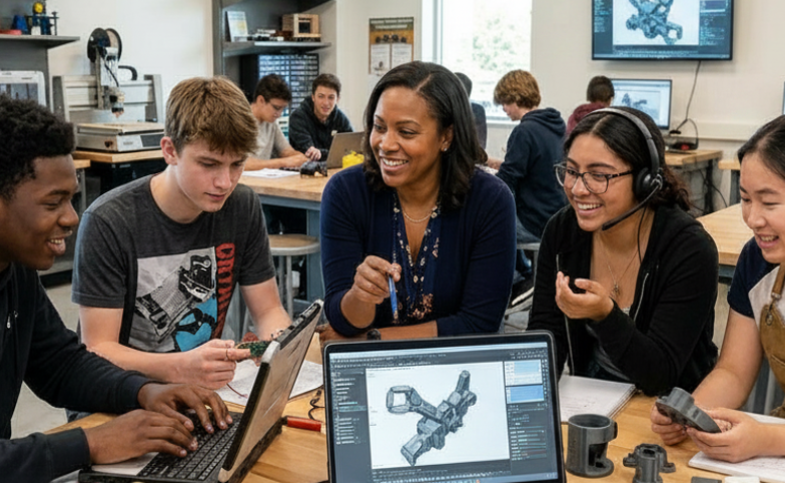
The session also highlighted how AI can support authentic learning across Career and Technical Education programs. Examples included automotive diagnostics, construction planning, health assisting, advanced manufacturing, programming and robotics, and design and visual communications.
Although the classroom activities vary from one pathway to another, the instructional approach remains remarkably consistent. AI becomes another professional tool that students learn to use responsibly while strengthening critical thinking, communication, creativity, and problem-solving skills they’ll carry into the workplace.
Continuing the Learning
One of the most practical messages from the session was also one of its simplest: start small.
Rather than redesigning an entire course, educators were encouraged to choose one classroom activity, one project, or one workflow where AI could support students’ thinking through planning, feedback, revision, or reflection. Those small experiences help students build confidence while developing the habits they’ll need as AI continues to evolve.
Whether you’re just beginning to explore AI in your classroom or looking for new ways to strengthen authentic learning, the session offers practical ideas that can be adapted across grade levels and career pathways.
Continue the Conversation
Interested in exploring these ideas further?
Download the complete presentation:
Learning to Learn AI with AI: Mind Shifts and Techniques for the Future of Work
Or visit our Beyond the Conference page to explore all four JFYNetWorks MAVA presentations, additional resources, and presentation downloads: