Making Waves in AI-Powered CTE: JFYNetWorks Heads to BPCTE 2026
Career and technical education has always been about turning knowledge into action. Students learn by designing, solving problems, working with tools and materials, and creating something that demonstrates what they know and can do.
AI can help students take that work further—but it shouldn’t take the work away from them.
That’s where the opportunity for CTE gets interesting.
The question isn’t simply whether students will use AI. It’s how AI can be used thoughtfully and responsibly to strengthen student thinking, support authentic project work, and prepare learners for workplaces where these technologies are increasingly part of the landscape—while preserving the hands-on learning, human judgment, and instructor expertise at the heart of career and technical education.
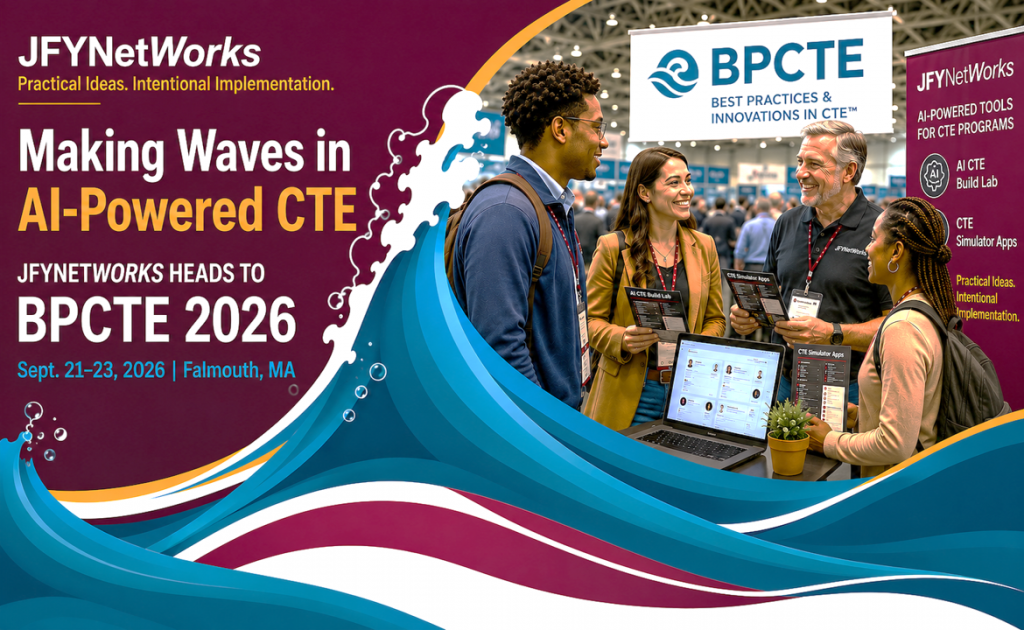
That is the conversation JFYNetWorks is bringing to the Best Practices & Innovations in CTE™ Conference (BPCTE), September 21–23, 2026, in Falmouth, Massachusetts.
This year’s conference marks BPCTE’s 20th anniversary, bringing together CTE leaders from secondary and postsecondary education for practical strategy, candid conversation, and professional collaboration. The conference is intentionally limited to 300 attendees, with an emphasis on meaningful exchange among the people responsible for CTE decisions, implementation, and results.
JFYNetWorks will be there—and we’re bringing something attendees can see in action.
What Does Responsible AI Look Like in the CTE Classroom?
For JFYNetWorks, using AI in career and technical education isn’t about replacing hands-on learning, student decision-making, or instructor expertise.
It’s about giving students another tool to help them move further through the work themselves.
A student may begin with an idea for a project, but turning that idea into something buildable requires much more: defining the goal, understanding available resources, working within real constraints, applying technical skills, documenting decisions, solving problems, and demonstrating progress.
AI can help students navigate that process. But the thinking, judgment, decision-making, and hands-on work still matter. So does the teacher.
JFYNetWorks‘ approach keeps educators in the loop while giving students an environment where they can explore ideas, develop plans, refine their work, and create durable evidence of what they have learned.
From Student Idea to Buildable Project
At BPCTE 2026, JFYNetWorks will demonstrate the JFYNet AI CTE Build Lab, featuring Project Spark.
Designed for students in Grades 10–12, the Build Lab turns capstone project guidelines and work-based learning requirements into an interactive, standards-aligned digital workspace.
A student can begin with an early project idea and the resources available to them, then work through the process of developing professional-grade, buildable project blueprints.
Along the way, the environment can support project navigation, build files, shop-floor documentation, skill badges, and progress tracking. Students can create exportable materials they can carry forward into a portfolio, co-op interview, or apprenticeship application.
Just as important are the boundaries built around the technology.
The Build Lab incorporates classroom-safe AI guardrails designed for CTE shop and lab environments, along with teacher-in-the-loop review and sign-off. AI can help students work through the process, but the instructor remains an essential part of reviewing the project and ensuring that the work remains aligned with instructional goals and standards.
The result isn’t AI doing the project for the student.
It’s AI helping create a structured environment in which students can develop an idea into something they can explain, document—and ultimately build.
Taking It Further With CTE Simulation
JFYNetWorks will also demonstrate the JFYNet AI CTE Simulator App, featuring Far-Fab.
Far-Fab is an interactive Industry 5.0 manufacturing simulator and durable-skills training environment for CTE students. It is aligned with the Massachusetts Chapter 74 Advanced Manufacturing Frameworks and designed as a hands-on complement to the AI CTE Build Lab.
Together, these tools point toward a larger possibility for AI in career and technical education.
Knowing how to prompt an AI system isn’t enough. Students also need opportunities to evaluate what AI gives them, make decisions, solve problems, communicate their reasoning, and translate digital work into real technical skills.
In other words, AI fluency doesn’t replace CTE skills. It becomes useful when students apply it alongside them.
That’s where the human side remains essential: the student’s creativity and judgment, the instructor’s experience and oversight, and the hands-on practice that turns knowledge into skill.
Those capabilities extend well beyond any single AI platform. They’re also the durable skills students will carry into postsecondary education, apprenticeships, co-ops, and careers.
Built for the People Making CTE Decisions
BPCTE is designed for the people responsible for moving CTE programs forward: superintendents and executive directors, principals and other school leaders, postsecondary and workforce education leaders, and the partners who support career and technical education.
That’s exactly why JFYNetWorks wants to be part of the conversation.
Responsible AI adoption raises practical questions.
How does AI fit into existing CTE pathways?
How can schools use it without diminishing hands-on learning?
How can instructors maintain meaningful oversight?
How can AI-supported work connect to authentic assessment, capstone projects, workforce preparation, and industry expectations?
And perhaps most importantly: What does this actually look like when students use it?
At BPCTE, we’re not just talking about the possibilities.
We’re showing them.
See AI-Powered CTE in Action at BPCTE 2026
JFYNetWorks will be exhibiting at the Best Practices & Innovations in CTE™ Conference, September 21–23, at the Sea Crest Beach Hotel in North Falmouth, Massachusetts.
Find us in the exhibit hall September 22–23.
Stop by the JFYNetWorks booth to:
- Meet the JFYNetWorks team
- See live demonstrations of the JFYNet AI CTE Build Lab and CTE Simulator Apps
- Ask questions and explore responsible AI adoption in CTE
- Talk through how AI-powered project work could fit your school’s or district’s CTE pathways
We’ll also be participating in networking events throughout the conference, so look for us and come say hello.
BPCTE 2026
September 21–23, 2026
Sea Crest Beach Hotel
North Falmouth, Massachusetts
JFYNetWorks Exhibiting: September 22–23
Ready to See What We’re Bringing to BPCTE?
Explore the tools we’ll be demonstrating, learn more about JFYNetWorks‘ approach to AI-powered CTE, and connect with our team before the conference.