

Why Every Point Counts on the Math MCAS—and What Educators Can Do Right Now
by Joan Reissman and Cathie Maglio
A practical look at how focused preparation in the final weeks can meaningfully impact student outcomes—and school performance.
With just 20 class days remaining before the Grade 10 Math MCAS, the question is —how to make the most of the time left.
At this point in the school year, every class period counts. And more importantly, every point on the test does too.
Why MCAS Still Carries Weight
Even though MCAS is no longer a graduation requirement, its role in school accountability hasn’t changed. MCAS scores remain the only academic measure used by the state to evaluate both student achievement and academic growth.
These scores directly influence a school’s standing in the state’s annual Accountability Report (80% in grades 3-8, 60% in high school) alongside graduation rates, absenteeism, and English language progress. But when it comes to academic performance, MCAS is the only metric.
And those rankings have real implications.
Lower performance can lead to declining enrollment. Declining enrollment affects funding. In more serious cases, it can trigger state intervention, mandated improvement plans, even receivership.
In short: MCAS still matters—for students, for schools, and for communities.
The Power of One More Point
Often overlooked is just how small the margin is between achievement levels.
On the 2025 Grade 10 Math MCAS, students could earn a total of 61 raw points across 42 questions. That means a single correct answer could shift a student from one performance level to the next.
- One point moves a student from Not Meeting Expectations to Partially Meeting
- One point moves a student from Partially Meeting to Meeting
- One point makes the difference between Meeting and Exceeding
That’s not a large gap—it’s a reachable one.
And it reframes the goal. Improving outcomes doesn’t always require dramatic gains. Sometimes, it’s about helping students get just one or two more questions right.
An Overlooked Opportunity: Constructed Response
Another area with significant potential to increase scores is constructed response.
These questions make up over a quarter of the total available points—yet many students skip them entirely.
Participation rates are surprisingly low, falling between 31% and 69% with most below 60%. That leaves a substantial number of points on the table.
A closer look at participation rates shows how much opportunity is being missed:
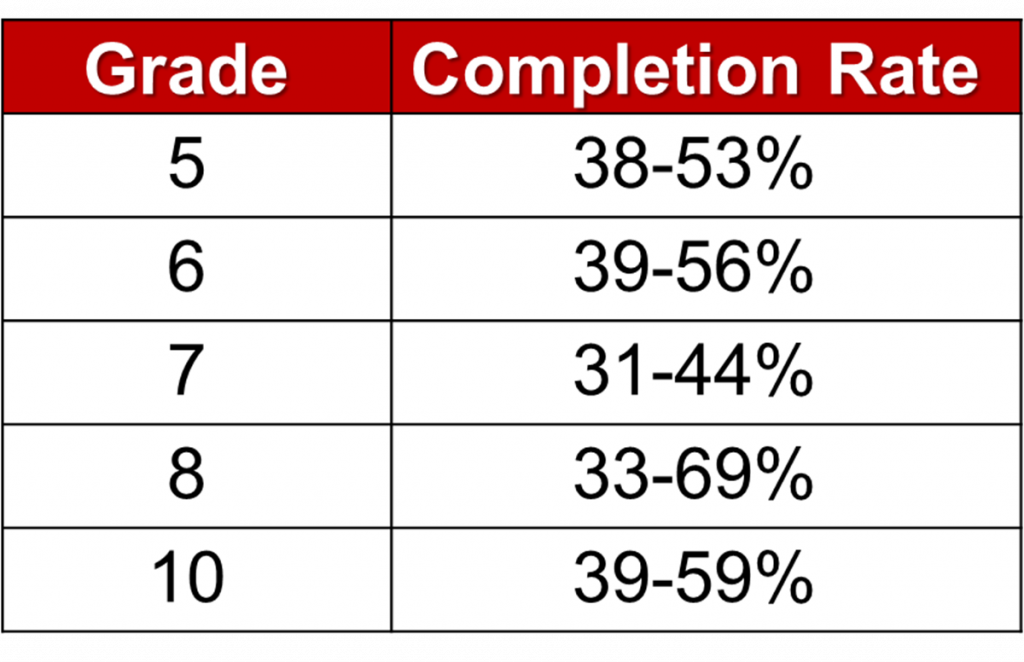
What students don’t realize is that these questions offer partial credit. Even starting the problem—writing the correct formula (with incorrect answers) or completing one step correctly—can earn points.
Encouraging students to attempt part of these questions is a potentially high-impact strategy.
What Can Be Done—Right Now
With limited time remaining, the focus needs to be practical and efficient.
One effective approach is short, targeted practice.
JFY has developed 5-minute math assignments aligned to the standards most likely to appear on the MCAS. These can be used at the beginning or end of class as quick “Do Now” exercises—providing consistent exposure without taking up too much instructional time.
For students who need more support, longer assignments are also available. But the key idea remains the same: small, consistent engagement with high-priority material.
Focusing on What Matters Most
Preparation is most effective when it’s targeted.
By analyzing MCAS 2.0 exams administered since 2019, JFY has identified the standards that appear most frequently. Nineteen standards have appeared five or six times and another fourteen have appeared four times. (There was no test in 2020.)
This historical pattern provides a clear roadmap.
Rather than trying to cover everything, educators can focus on the content most likely to have an impact—maximizing both time and results.
Beyond the Test: Real Incentives for Students
For students, MCAS performance can open doors to college.
Massachusetts offers two scholarships tied directly to MCAS results: the John and Abigail Adams Scholarship and the Stanley Z. Koplik Certificate of Mastery. These programs provide tuition benefits for students who achieve high scores in Grade 10.
That’s a tangible outcome—one that can help motivate effort during these final weeks.
Small Actions, Big Results
At this stage, the message is simple.
Small actions matter.
Encourage students to attempt every question.
Focus on high-impact standards.
Build in just a few minutes of targeted practice each day.
These aren’t large shifts—but they can produce meaningful results.
Because on the Math MCAS, one more point can have a significant impact.
It’s an opportunity—for the student, for the family, and for the school.
👉 Explore more MCAS insights and strategies:
https://jfynet.org/category/mcas/
Joan Reissman and Cathy Maglio are veteran JFYNetWorks Learning Specialists